
Companion Plants
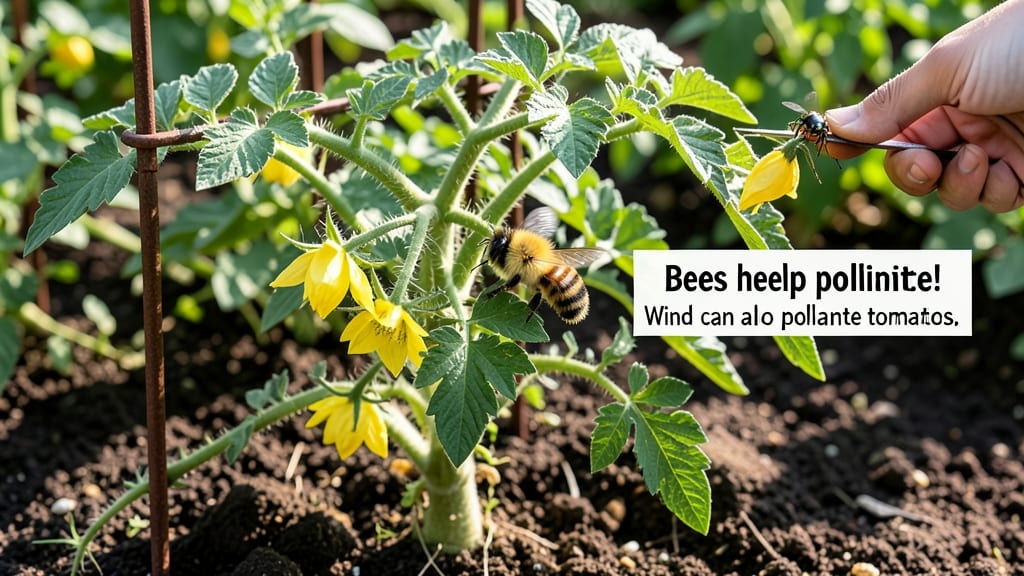
Tomato plants don't strictly need bees to pollinate, since their flowers self-pollinate through wind or gentle movement, but bees boost fruit production by enhancing cross-pollination. For indoor gardens or areas without pollinators, hand-pollination delivers reliable results.
Tomatoes are self-pollinating, meaning their flowers transfer pollen internally without relying on outside help. 🌱 The key lies in their flower structure—petals curl back to expose pollen to wind or vibrations, while gravity helps pollen settle on the stigma.
While bees aren't essential, they increase fruit set by up to 30% through cross-pollination, which strengthens plant resilience and yield consistency. This makes manual methods like shaking plants or using a small brush especially valuable for container growers or indoor setups.
For best results, pollinate in the morning when flowers are fresh and humidity is lower. A simple cotton swab or paintbrush works perfectly to transfer pollen between flowers. I've found this method particularly effective for heirloom varieties, which often produce larger but fewer fruits without proper pollination support.
💡 In This Article
- How Tomato Flowers Self-Pollinate Without Bees
- Best Manual Pollination Techniques for Tomato Plants
How tomato flowers self-pollinate without bees
Tomato flowers are designed as perfect flowers, meaning they contain both male (anthers) and female (stigma) reproductive parts within the same bloom. The petals naturally curl backward when the flower opens, exposing the anthers (pollen-producing structures) to wind currents or vibrations.
This design creates a built-in mechanism where pollen grains—measuring just 0.002-0.005 inches in diameter—are easily dislodged and carried by air currents to the stigma at the flower's center.
The process relies heavily on gravity and vibration. When wind or even a gentle breeze passes through the garden, it causes the flower's delicate structures to vibrate, releasing pollen clouds that settle onto receptive stigmas.
Studies show that natural wind pollination can achieve 60-70% fruit set in optimal conditions, though this varies by tomato variety. For example, cherry tomatoes often self-pollinate more efficiently than beefsteak varieties due to their smaller, more flexible flowers that respond better to air movement. 🌬️
Bees play a different role by facilitating cross-pollination—transferring pollen between flowers on separate plants. This genetic mixing produces fruits with stronger cell walls, better disease resistance, and more consistent ripening. Without bees, self-pollinated tomatoes may show 10-30% lower yields and occasional blossom-end rot due to less genetic diversity.
The key difference lies in fruit quality: bee-pollinated tomatoes often develop more complex flavors and firmer textures, while self-pollinated ones prioritize quantity over nuanced taste profiles.
Gravity becomes the final player in this natural system. Once pollen lands on the stigma, it must travel down the style tube—a process that takes 12-24 hours—before fertilization can occur.
This explains why pollinating in the morning gives pollen the best chance to complete this journey before afternoon heat causes flower wilting. The stigma's sticky surface captures pollen particles through electrostatic forces, creating a microscopic bridge that triggers fertilization when conditions are right.
For gardeners working with determinate varieties (which produce all fruits at once), self-pollination often suffices because the plant's energy focuses on rapid fruit development. However, indeterminate varieties—which continue producing flowers throughout the season—benefit more from cross-pollination because their staggered flowering patterns create more opportunities for genetic mixing.
This is why you might notice larger, more uniform fruits on bee-visited plants compared to their self-pollinated counterparts.
Understanding this process helps explain why indoor growers often struggle with poor fruit set. Without wind or pollinators, pollen may not transfer efficiently, leading to blossom drop—where flowers abort before fruiting.
The solution lies in mimicking nature's mechanisms through controlled vibrations or manual methods, which we'll explore in the next section. 🔬