
Vegetables
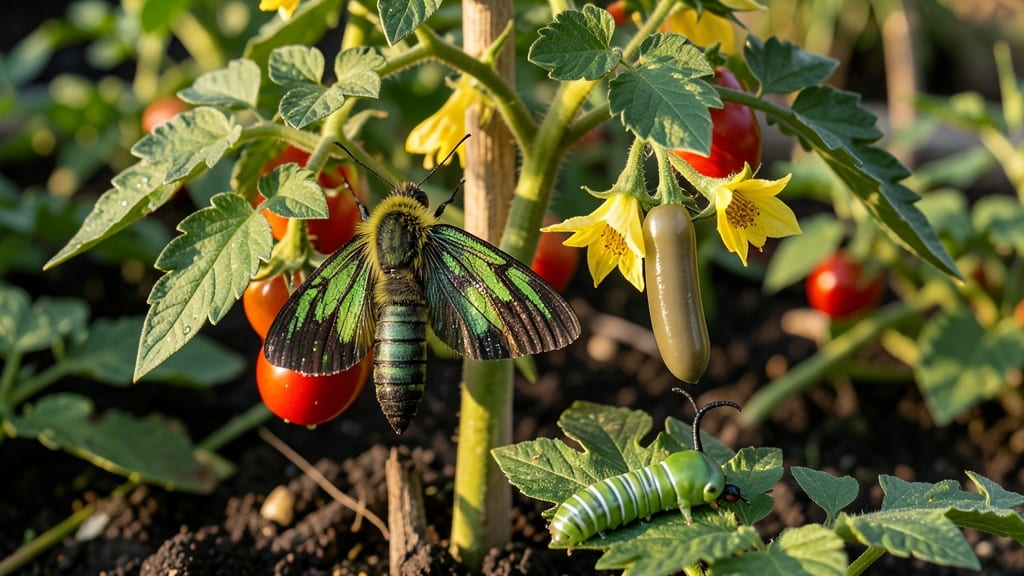
Tomato hornworms turn into five-spotted hawk moths (Manduca quinquemaculata), striking nocturnal pollinators with a 4-5 inch wingspan, recognizable by their green bodies, white spots, and long proboscis for nectar feeding.
These dramatic caterpillars undergo complete metamorphosis, starting with a 7-10 day pupation period inside silken cocoons buried in soil. 🌿 The resulting moths play a crucial ecological role by pollinating night-blooming flowers like moonflowers and evening primrose, often outcompeting bees with their specialized proboscis.
What's fascinating is how their green bodies blend perfectly with foliage during daylight hours, while their nocturnal habits make them perfect pollinators for plants that rely on moonlit visitors.
Gardeners can encourage this transformation by planting host plants like tomatoes and tobacco, which provide both food for larvae and nectar sources for adults. Avoiding artificial lights helps protect these beneficial insects, as their flight patterns are naturally guided by moonlight.
The entire life cycle from egg to adult typically takes about 35-40 days, making them one of the fastest-developing garden moth species.
💡 In This Article
- The Tomato Hornworm’s Complete Metamorphosis Process
- Identifying and Supporting Hawk Moths in Your Garden
The tomato hornworm’s complete metamorphosis process
The tomato hornworm's transformation begins when it reaches full size—typically around 3 inches long—after consuming up to 20 tomato plants in its larval stage. At this point, it seeks a sheltered spot, often near the base of its host plant, to initiate pupation.
The caterpillar first spins a silken cocoon around itself, then secretes a hard, brown shell that hardens within 24 hours. This pupal stage is where the magic happens: inside, the caterpillar's body completely dissolves and reorganizes into an adult moth through a process called histolysis.
Temperature is the critical factor controlling how quickly this metamorphosis occurs. At 77°F (25°C), the pupation period lasts about 7-10 days, while cooler temperatures (68°F/20°C) can extend it to 2-3 weeks.
What's fascinating is the hormonal trigger: the caterpillar's brain releases a hormone called prothoracicotropic hormone (PTTH) that signals the prothoracic glands to produce ecdysone, the molting hormone that kickstarts pupation. This hormonal cascade explains why stressed hornworms may fail to pupate properly.
During this time, the developing moth undergoes dramatic physical changes. The caterpillar's digestive system, muscles, and even its exoskeleton are broken down and recycled into new adult structures. The wings, initially folded inside the pupal case, begin to expand as fluids fill them, preparing for the final emergence.
The 4-5 inch wingspan of the adult emerges from this compact pupal case through a precise splitting of the cocoon along predetermined weak points.
The final emergence is a precise biological event. The adult moth uses a specialized structure called the pupal ecdysial suture to split its cocoon open, then inflates its wings using hemolymph (insect "blood") before taking its first flight.
This entire process is timed with environmental cues—typically emerging at dusk when temperatures are optimal for flight. The newly emerged moths have a bright green body with distinctive white diagonal stripes on their abdomen, which helps them blend into foliage during daylight hours.
One surprising fact is that these moths don't eat as adults—their entire focus is on reproduction and pollination. Within 24-48 hours of emergence, females begin laying eggs (up to 200 in their lifetime) on host plants, completing the cycle.
The speed of this transformation—from egg to adult in just 35-40 days—makes the tomato hornworm one of nature's most efficient life cycle systems. 🌱
Gardeners often find these pupal cases attached to stems or buried in soil. If you discover one, resist the urge to remove it—you're witnessing the creation of a vital pollinator!
The moth's emergence is often accompanied by a distinctive cracking sound as the wings expand, a true testament to nature's engineering. This complete metamorphosis isn't just biological—it's an ecological powerhouse that keeps gardens thriving.